NEXUS-NESS
Durata:
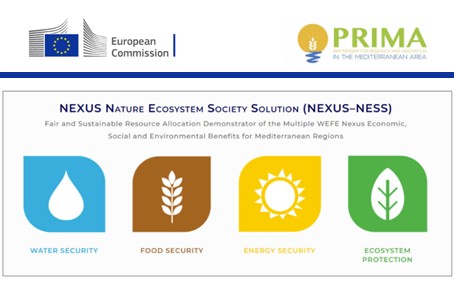
The NEXUS Nature Ecosystem Society project (or NEXUS-NESS) aims to co-produce and co-test WEFE Nexus management plans together with stakeholders for a fair and sustainable allocation of resources. NEXUS-NESS will apply transdisciplinary methods and multisectoral scenarios by integrating the large-scale WATNEEDS models and the basin-scale ecosystem-hydrological models FREEWAT, in order to build a dedicated service to operationalize the proposed WEFE Nexus approach, called the NEXUS-NESS Service.
This new service will transfer and test science-based knowledge on the WEFE Nexus to address real-world problems in the case studies. The NEXUS-NESS solution will link the components of the WEF Nexus with a threefold conceptualization of the Ecosystem component (Environment, Economy, Engagement/Society). NEXUS-NESS will adopt and test the bottom-up approach of the WEFE Nexus in four demonstration sites characterized by different climatic, environmental, socioeconomic, and cultural conditions, employing the principles of Living Labs and Responsible Research and Innovation (RRI). Four Nexus Ecosystem Labs will be established in Italy, Spain, Egypt, and Tunisia.
An Ecosystemic Approach to WEFE Nexus Innovation, supported by a new Multistakeholder and User-centered Platform, will effectively engage all stakeholders, including the private sector, to create lasting innovation ecosystems based on collaboration between academia, industry, various levels of the public sector, and citizens.
Purpose:
The general objective of the “Fair and Sustainable Resource Allocation Demonstrator of WEFE Nexus Economic, Social and Environmental Benefits in the Mediterranean Region” project – known as NEXUS Nature Ecosystem Society Solution (NEXUS-NESS) – is structured into the following General Objectives (GO) and related Specific Objectives (SO): GO.1) Co-produce and co-test Nexus WEFE management plans with stakeholders for fair and sustainable resource allocation, applying Nexus WEFE data, knowledge and tools under real-world conditions, GO.2) Operationalize the adoption of the WEFE Nexus by co-defining short- and long-term resource management plans and operational guidelines (GO.1), testing them in the four NEL, GO.3) Implement an Ecosystemic Approach to WEFE Nexus Innovation (IEA) by applying the principles of Responsible Research and Innovation (RRI) through the RRI Roadmap in the 4 NEL, also developing a Multi-Stakeholder and User Platform (MSUP) to effectively engage all stakeholders, including the private sector, creating lasting innovation ecosystems based on collaboration between academia, industry, the public sector and citizens. GO.4 Connecting innovation ecosystems starting from the 4 NEL will provide operational guidelines and best practices to be integrated into the WEFE Nexus Atlas of JRC, UfM, and GWP-Med, ensuring transferability and adaptation of best practices to other regions, thus expanding the scale and value of the proposed multi-sectoral and multi-actor approach.
Coordinator:
Team:
Prof. Chiara Biscarini, Prof. Giovanni Capecchi, Prof. Federica Guazzini, Dr. Manuela Radice, Dr. Margarita Fursova, Dr. Margherita Nardi, Dr. Francesco Minutella, Dr. Heba Hidriss, Dr. Andrea Paolini, Dr. Antonio Annis, Dr. Andrea Spasiano.